


Waterfall Downstands on Islands and Worktops
In a recent article, we talked over some of the benefits and challenges of the ever-popular kitchen island. One aspect to current kitchen design, often involving islands, is the waterfall downstand, or end panel. A number of questions come up about them, and this article tries to collect them all under one roof, so to speak.
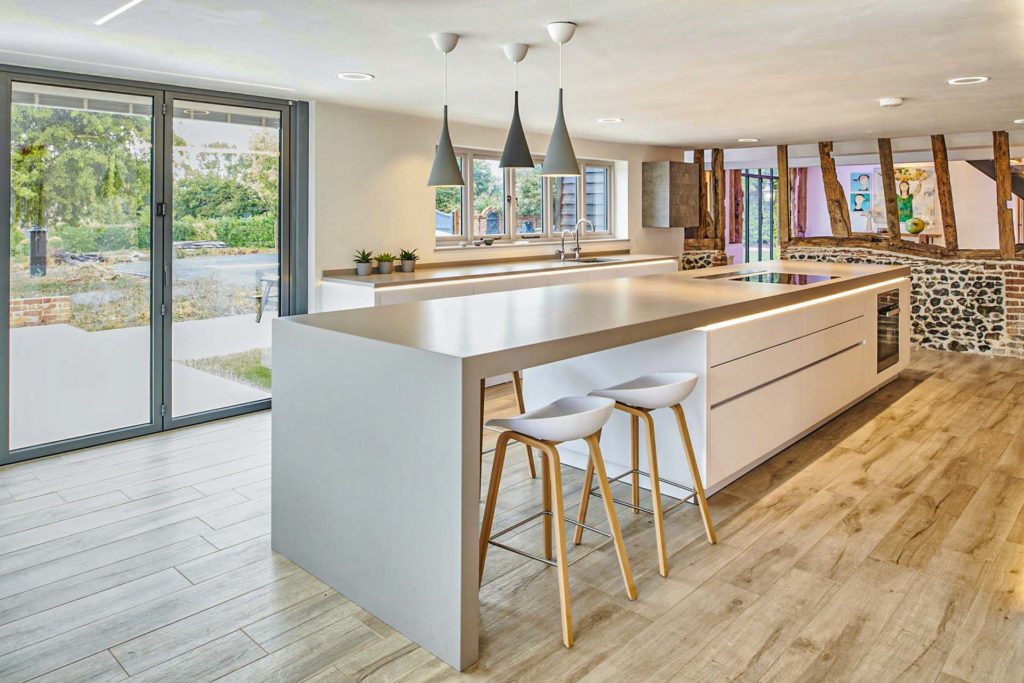
A waterfall downstand is a section of stone, usually (but not always) the same width as the top it joins to, which runs down to the floor. The idea, especially in stones with a degree of linear pattern or flow, is that the stone flows down from the top to the floor, like a waterfall.
Waterfall downstands are most often seen on islands, but every so often we make one at the open end of a quartz or granite worktop run.
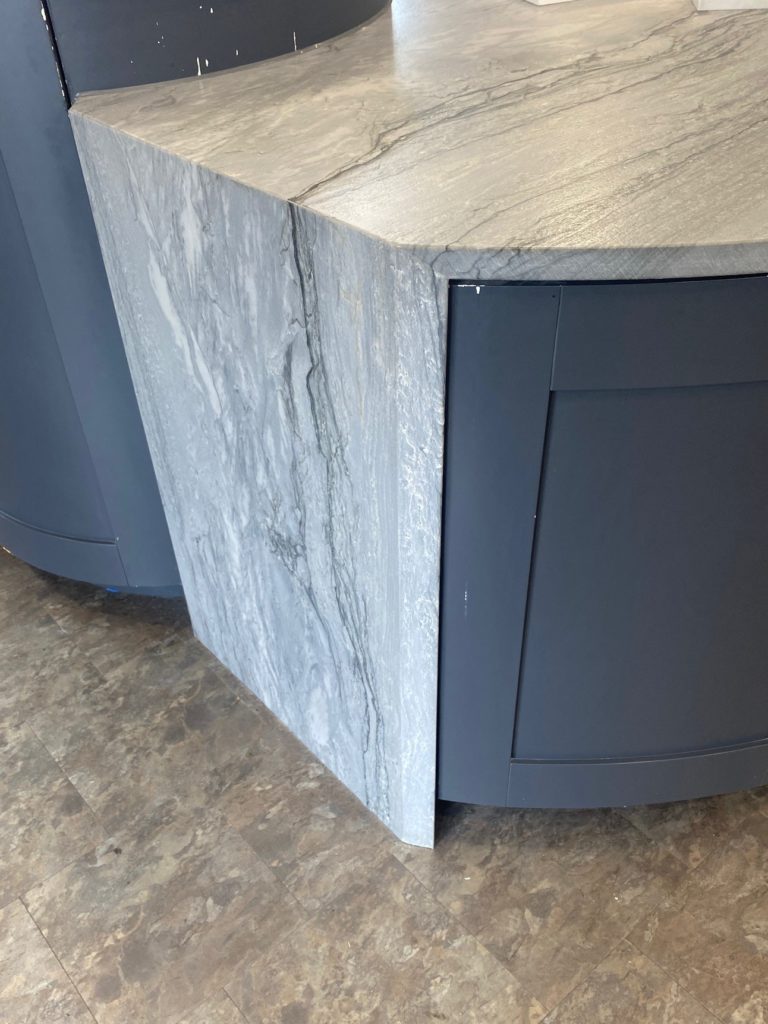
Mitred downstand
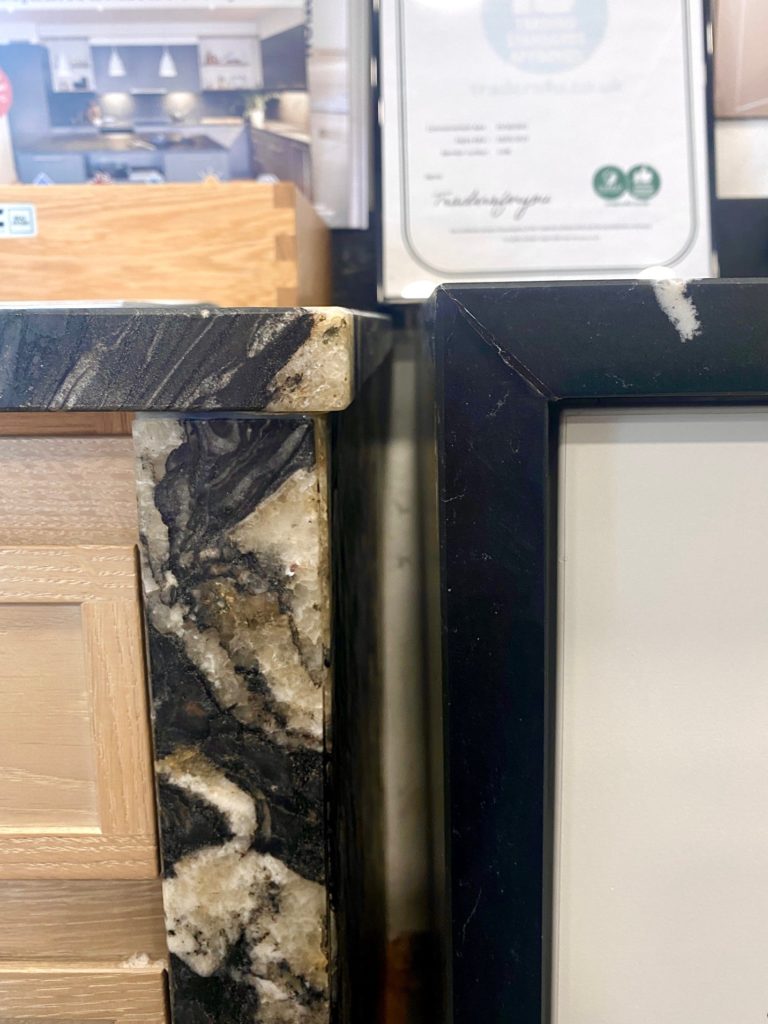
Butted downstand (left) and Mitred downstand (right)
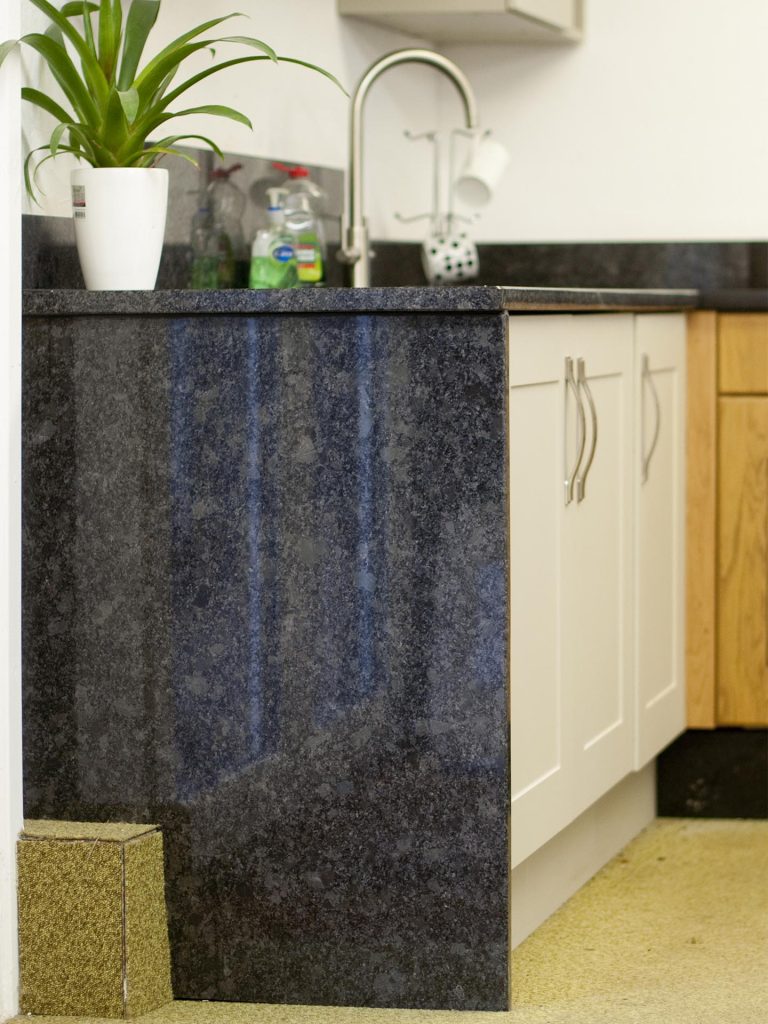
Butted downstand
Types of downstand join – images of examples in our own showroom
There are two ways of joining the stone to create a waterfall downstand:
The butt join, where the worktop simply sits on and overhangs the downstand, is simpler and cheap to install. It suits more traditional kitchens where the worktops have fairly strong overhangs anyway.
The mitred join, where the worktop and downstand are both cut at 45° and resined together with a slight bevel on the sharp edge is technically harder to do, but gives the best waterfall flow through the join and down, and suits strongly patterned materials and modern style kitchens with minimised overhangs.
So can we make mitred downstands?
Absolutely! Mitred waterfall ends are a finish we create regularly, and they are a great way to give a kitchen island a sleek, continuous appearance. The worktop extends down the side of the island to the floor, with the stone’s pattern flowing around the corner to create the impression of a single, seamless piece.
This question has been coming up more frequently because some of the larger kitchen companies that have entered the solid stone worktop market have moved away from mitred joints, offering butted joins instead. With a butted joint, the horizontal worktop simply overlaps the vertical downstand, leaving a more obvious junction between the two pieces and losing the sense of perfect “flow” of the stone and its vein/pattern.
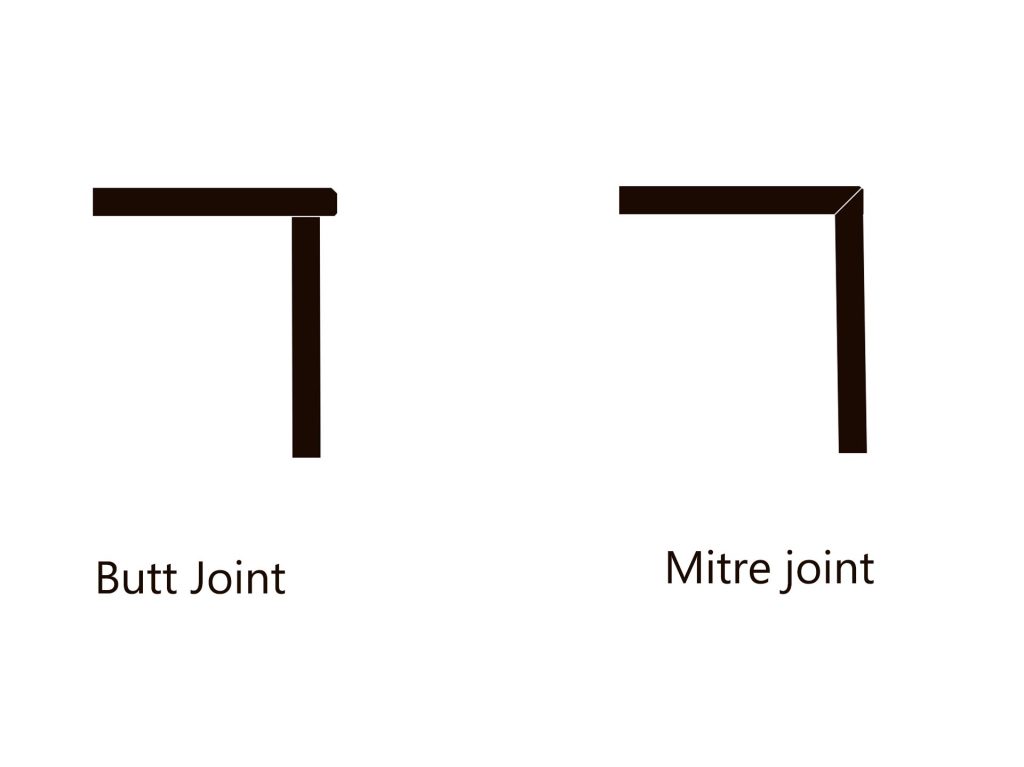
Diagram of the join types for waterfall downstands

Horizonstone Calacatta Bronzite with mitred downstand
Butt joins are cheaper to make, with far less risk of having to replace everything if there is a small error in the measurements or cutting. That is the reason mitred downstands are not offered by everyone. Achieving a really good result requires considerable skill, precision cutting and careful finishing. Accuracy in cutting is paramount, especially where there are mitred joins at both ends of the island. Mistakes can be costly, both in materials and in the time needed to put them right, so it is understandable that some companies prefer the simpler and cheaper alternative.
At Affordable Granite, however, we are proud of our mitred work. We have the experience, equipment and craftsmanship needed to produce this finish, and we manufacture mitred waterfall ends for kitchen islands on a regular basis. Whether you are choosing quartz or granite, a well-executed mitred downstand can make a real difference to the finished appearance of your kitchen.
Mitred waterfall ends are just one more reason to choose a specialist quartz and granite worktop company rather than buying your worktops through a large kitchen retailer. When the details matter, the expertise of a dedicated stone fabricator can make all the difference.
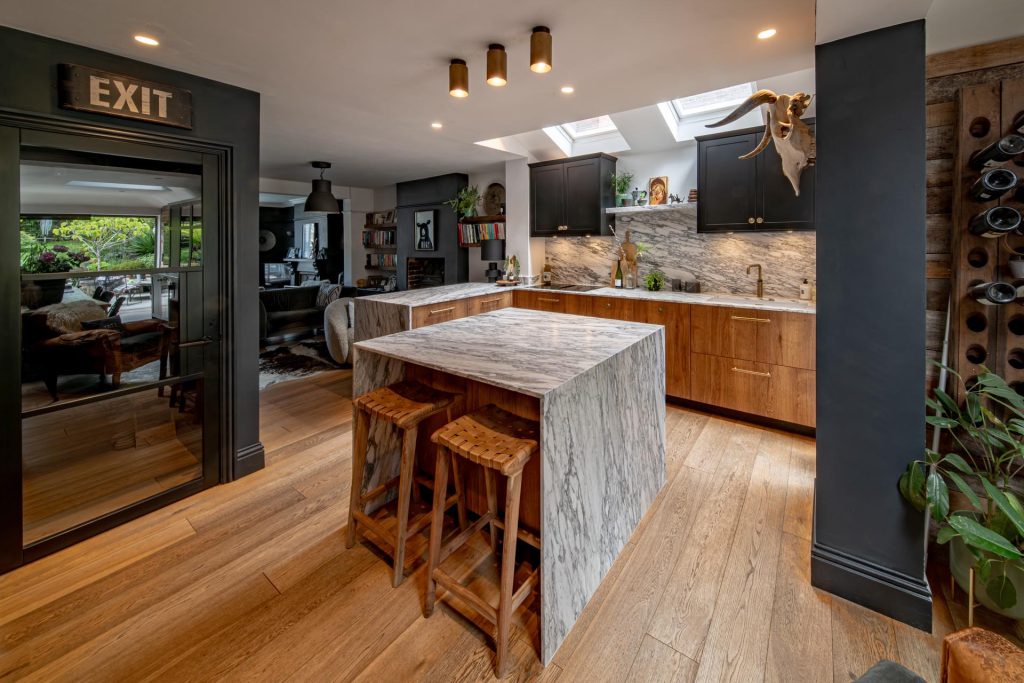
Small Arabescato Cerviole island with mitred downstands at both sides
Are there any other issues with waterfall downstands that I need to think about?
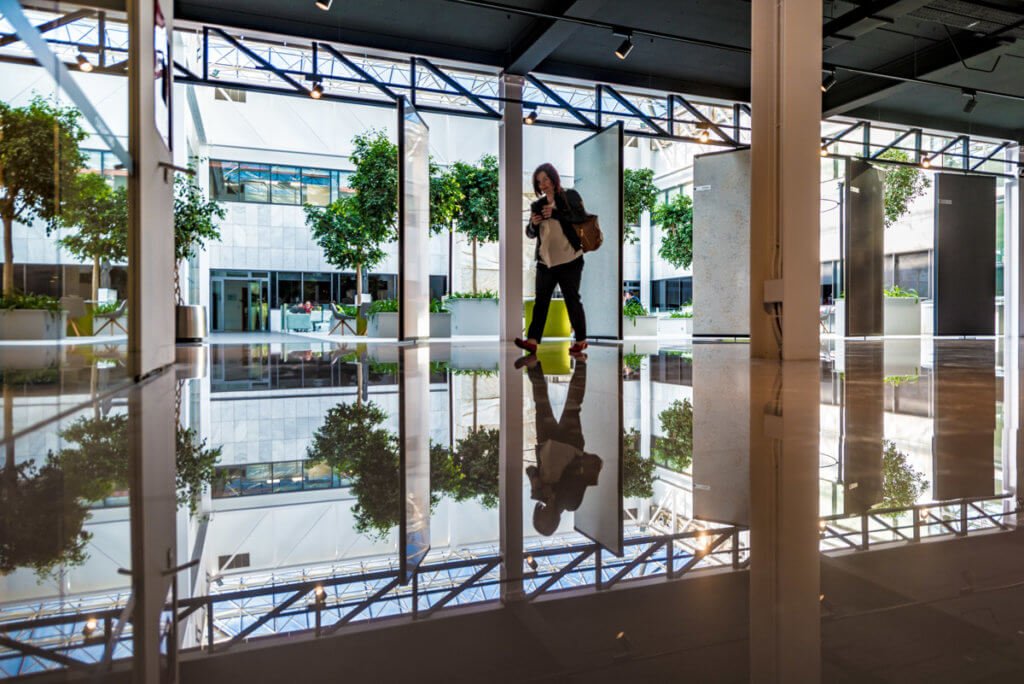
A high gloss Dekton floor at Cosentino headquarters, Spain.
High Gloss ceramic / sintered particle stones
We do not offer mitred downstands in high gloss ceramic materials – such as the Dekton X-Gloss shown as flooring here. The gloss finish is effectively a thin layer of glass on the sintered material – which is virtually impossible to cut at a 45° angle without chipping.
So we draw the line with high gloss ceramics – and also do not offer recessed drainers and drainer grooves in them, for related reasons.
Vein flow and slab size
The ideal waterfall downstand is made out of a single slab, so that the same veins genuinely break and turn over the edge. It needs to be borne in mind that this is often impossible: if the total length of the worktop/island and its downstand exceeds the length of the slab then compromises will need to be made. As the distance from worktop height to the floor is approximately 900mm, then in a typical quartz slab at 3200mm long, the island needs to be 2300mm or less for a perfect flow. These days, that is relatively short.
Add a waterfall downstand at the other end and the situation is even more limiting, with more than half the quartz slab being taken up with the downstands.

Silestone Eternal Pearl Jasmine
Do not despair though. There are solutions:
Where two waterfall downstands are required, we are usually able to maximise good vein matching at the more visible end, with a rougher approximation at the other end.
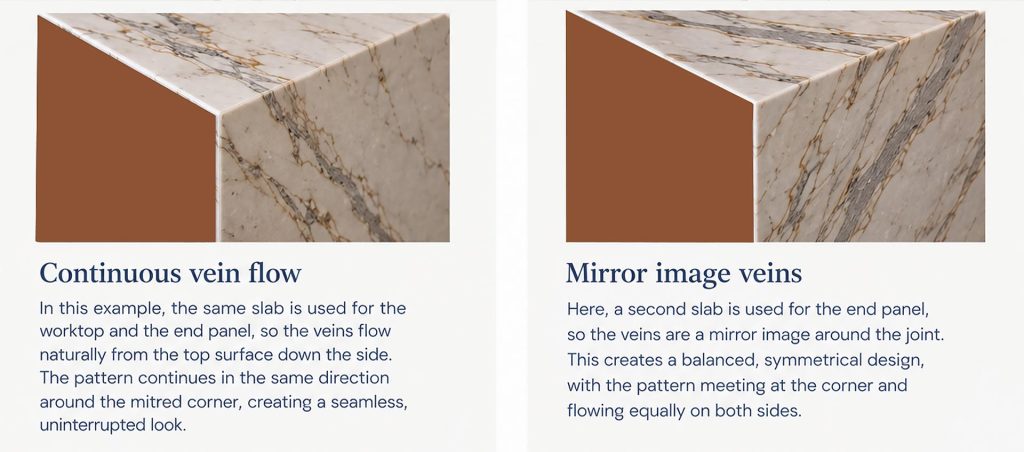
Veins can match without the flow continuing in the same line – we can use two identical slabs to create a more or less mirror-image vein match on the end panels. (See diagram). Given that quartz slabs are generally reasonably close copies of each other – and some manufacturers create mirror-image slabs anyway, giving us more options – this is often far more feasible than it sounds.
When all else fails we can try to plan the cuts so that no major vein goes over the edge (possibly at the less visible end only) – although that kind of spoils the fun!
Back Polishing of Waterfall Downstands
Where a downstand backs onto a void, rather than a unit – for instance at the end of a breakfast bar – the underside of the stone is visible. This may be another reason for the unwillingness of certain kitchen companies to do downstands at all. To do a good job, the stone either needs to be layered so that two “top” surfaces are visible (a skilled procedure anyway) or the underside needs to be polished, and they probably don’t have the kit to do it.
We can do this – our Jenny Lind stands ready to serve you! Not a member of the sales team, nor the 19th century singer, but a machine named after her which can polish stone faces to a pretty good standard. We regularly install waterfall downstands, polished on both faces.
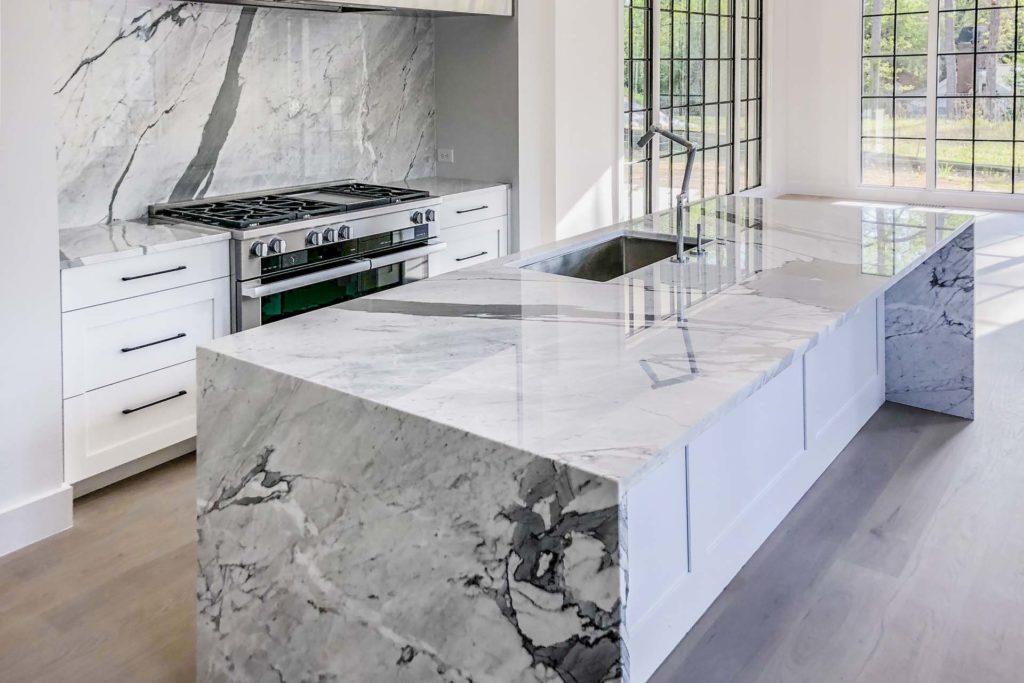
Granite worktops and island – with underpolished downstand visible
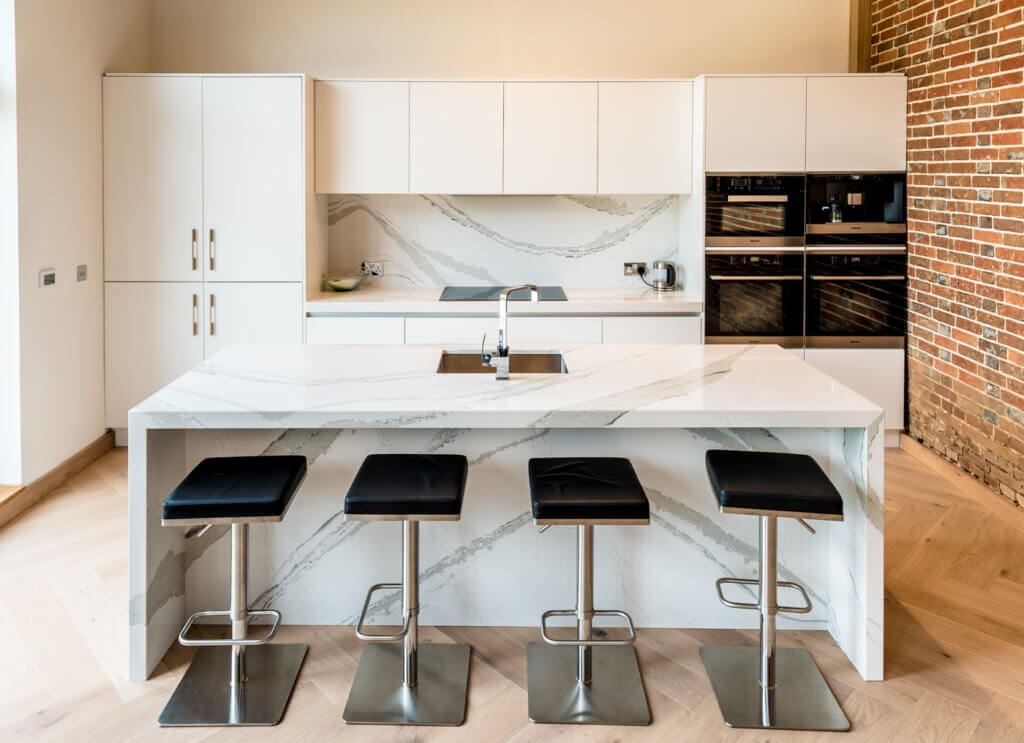
Cambria Brittanicca island – with waterfall downstands at both ends, and built up to 60mm thickness throughout. A mitring tour de force for our stonemasons!
See full case study.
Planning a kitchen and thinking about waterfall downstands?! Give us a call and talk over your plans – we are here to help!
We are Affordable Granite: If you want to enquire about granite worktops, quartz islands, ceramic peninsulas or any other aspect of solid stone installation, please feel free to contact us on 01293 863992 or [email protected]
Images copyright © Andrew King Photography or from suppliers
