


What is the difference between granite and quartz? Which is better?
The question about granite and quartz is just one of many questions about different kitchen countertops options. For a general round up of all kinds of worktops materials, please see our “Worktop materials” article.
What is the difference between granite and quartz? And which is better? These are probably the two questions we are asked most frequently. The answer to the first is relatively straightforward; the second is rather more complicated! Put simply, the main difference is that one is natural stone and the other is man-made.
Granite is natural; quartz is man-made.
In our industry, what we call “granite” is not necessarily what a geologist would technically classify as granite. The term describes a variety of different natural stones, all of which are hard and suitable for use as kitchen worktops. In other words, granite worktops are made from natural rock that has been quarried from the ground.
“Quartz”, on the other hand, is a man-made product, more accurately known as engineered stone. It is manufactured by mixing small pieces of natural stone, glass, mirror and other hard materials with a petrochemical resin. This mixture is then compressed under high pressure in specialised factory machinery. Some products also have dyes and pigments added to create colours and patterns that mimic the natural veining found in stone. However convincing the appearance, though, quartz is a manufactured product rather than a natural stone.
Our industry is going through a process of considerable change at present and the word quartz is gradually being dropped. See here for more information.
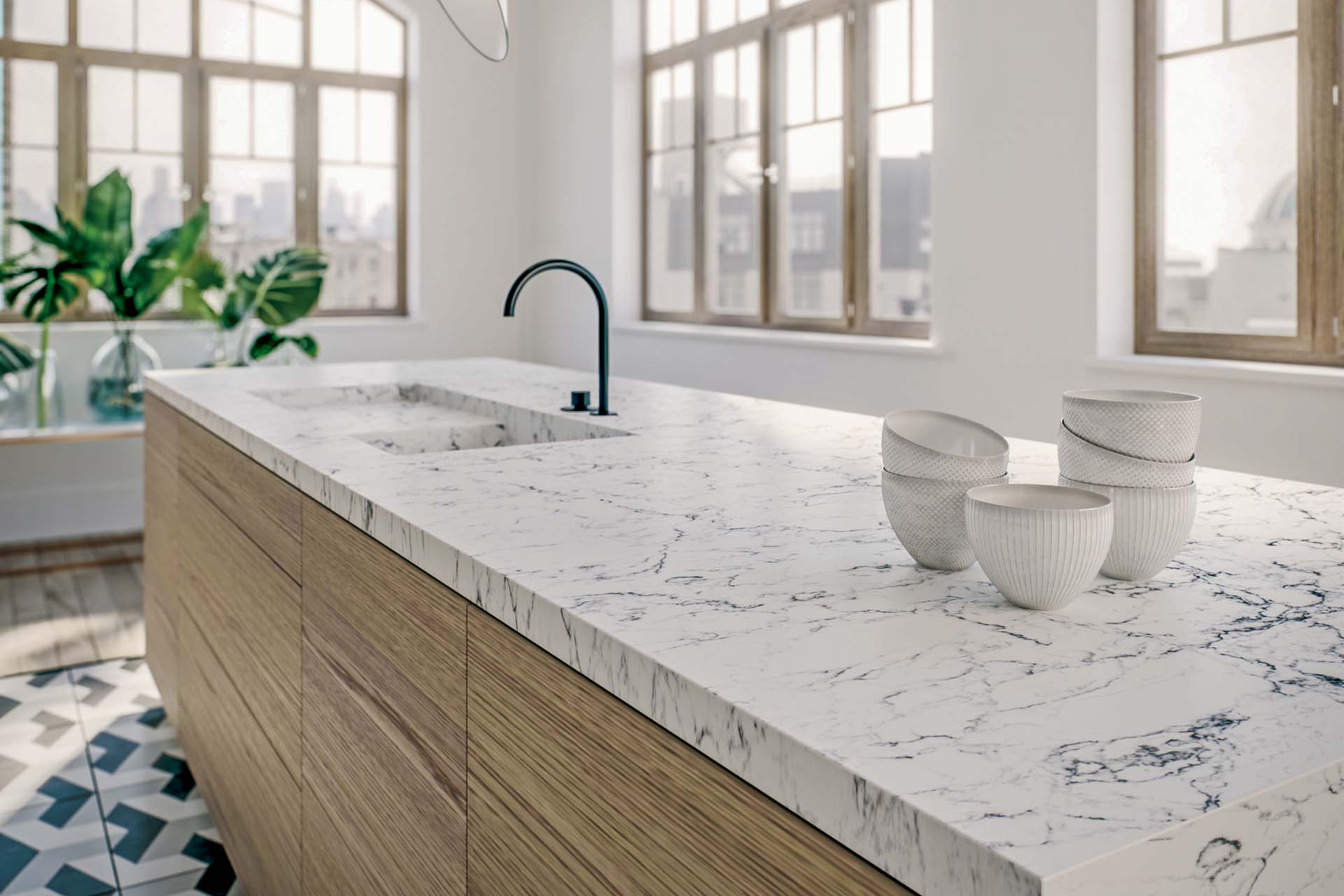
Caesarstone White Attica Quartz Island
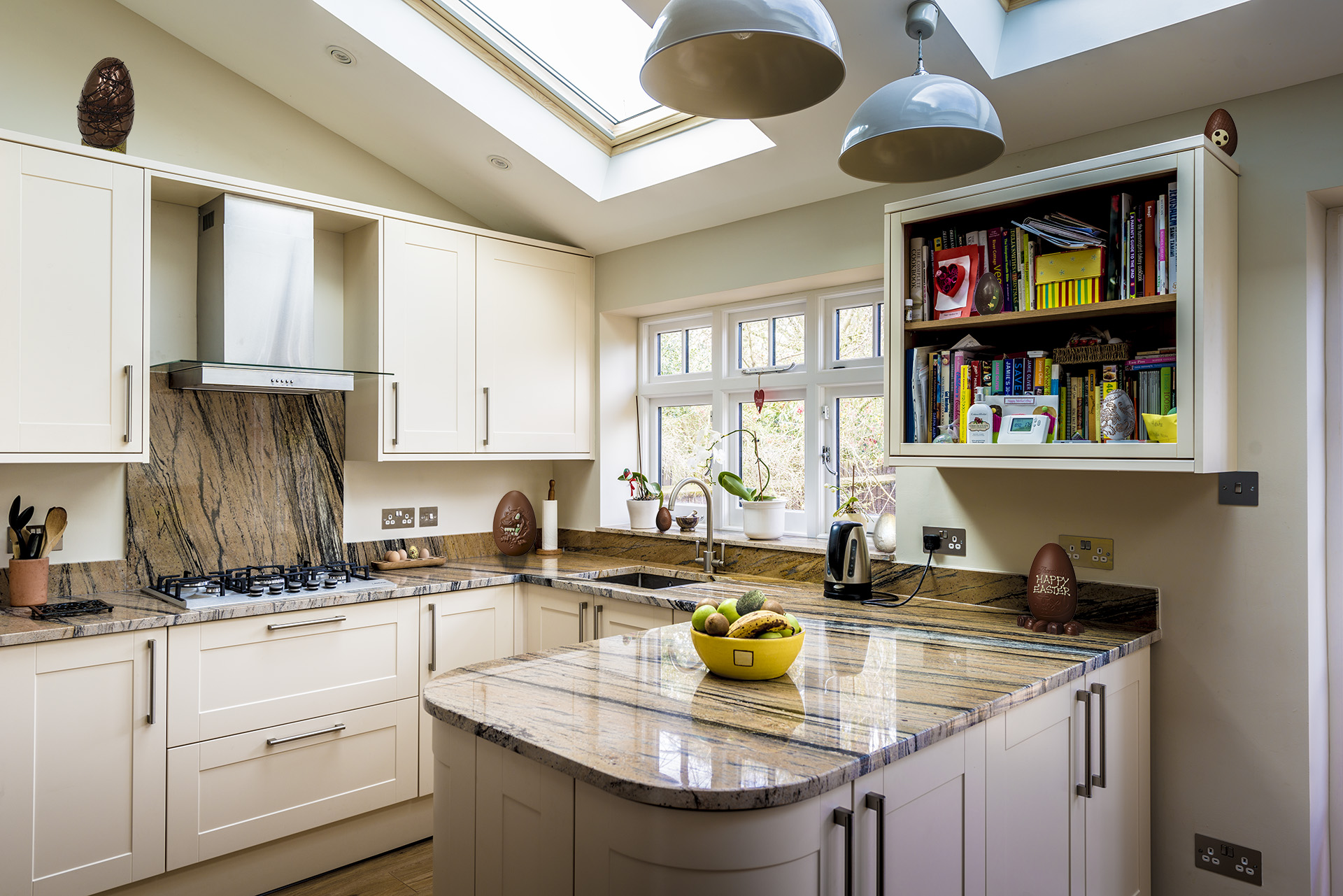
Lemon Spice Granite Worktops in Teddington
1 Staining
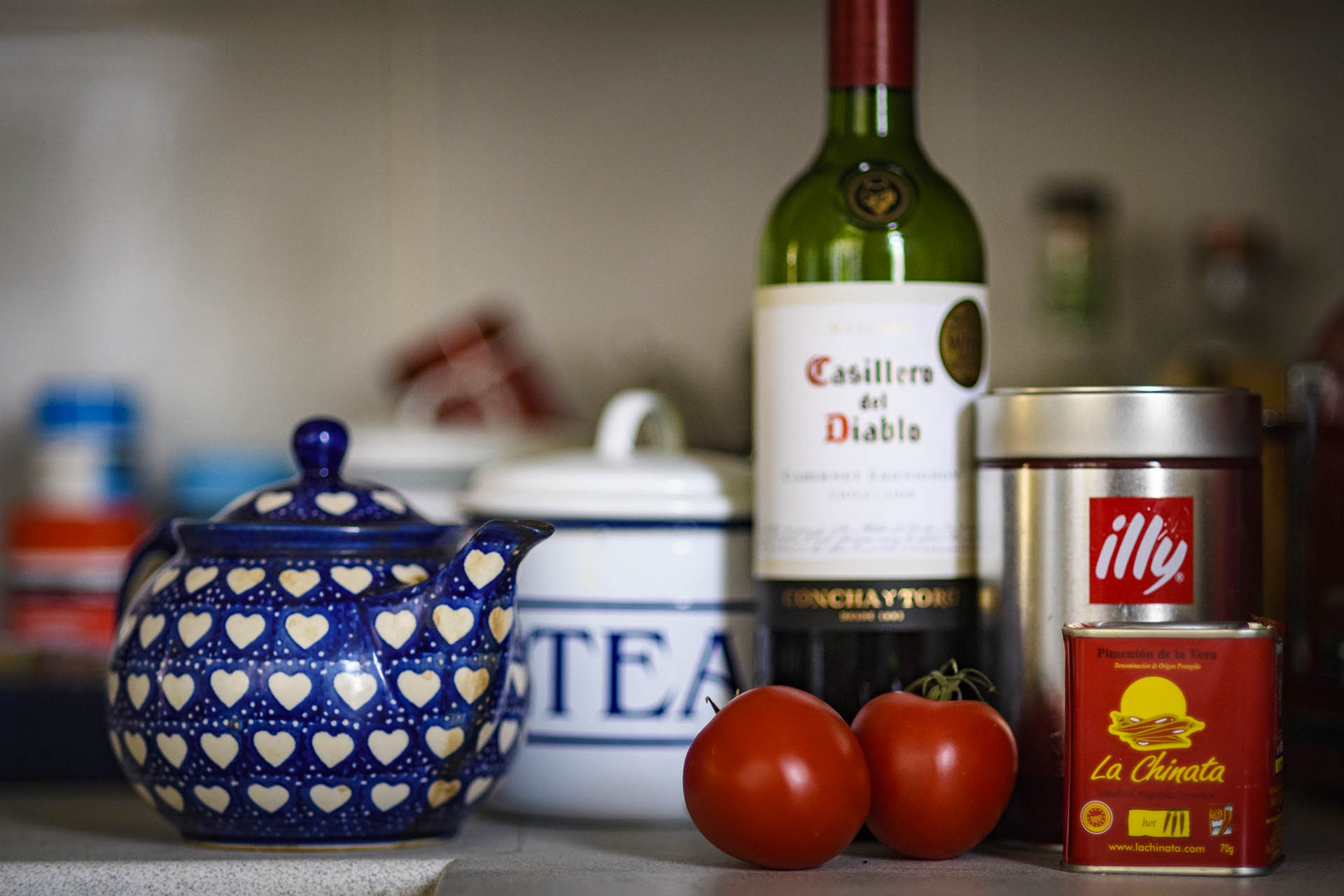

Coffee marks on a quartz worktop
The second question, “Which is better?”, is rather more complicated. Our general rule of thumb is to recommend granite in darker colours and quartz in lighter colours. Here is why.
Many everyday kitchen substances can mark or stain worktops. Obvious examples include tea, coffee and wine, which are water-based, and tomato, spices (particularly paprika and turmeric), which can be especially troublesome when carried in oil.
Staining can be divided into two categories: surface staining and subsurface staining.
Surface staining can affect all worktop materials. Food residues and other pigmented substances can leave marks on the surface. Think of anything from spilled food and drink to paint from toddlers’ art projects, or greasy fingerprints left behind after working on a car or bicycle!
Subsurface staining, however, can only happen when the material has pores through which substances can penetrate, and where the worktop is translucent or partially transparent. This is most likely to be an issue with certain light-coloured granites. Their crystalline structure can allow liquids to seep below the surface, where the resulting stain may actually be visible within the stone itself.
It is worth pointing out that quartz manufacturers often claim that “granite stains but quartz doesn’t”. What they are really referring to is subsurface staining, and on that particular point they are correct. However, subsurface staining is only part of the picture, and this frequently repeated claim can be seriously misleading. Read on to find out why.
Surface Staining
In general, highly polished surfaces are easier to clean and keep stain-free than matt ones. Unless you choose a honed, leathered, caress or other specialist finish, your granite worktops will have a glossy, highly polished surface. This makes them behave rather like glass, ceramic or stainless steel when it comes to cleaning. Polished granite is really good!
Quartz is also available in a range of non-polished finishes, often marketed under names such as Velluto or Suede. The important point, though, is that even a quartz surface described as “polished” is generally much less shiny than polished granite. This can make stubborn stains more difficult to remove. And on the very popular white marble-effect and other light-coloured quartz worktops, any remaining marks can be particularly noticeable.
This is not disastrous news, and we still generally recommend light-coloured quartz. However, we believe it is important to be open about this issue, particularly when some quartz manufacturers tend to gloss over it, to say the least!
Based on our own testing and experience, we would also say that the better-known, premium quartz brands tend to perform better in this respect. As with so many things, you get what you pay for, and the easiest surfaces to clean and maintain are generally found among the products from the established big names.

Reflection on the surface of a Steel Grey Granite worktop in West Sussex
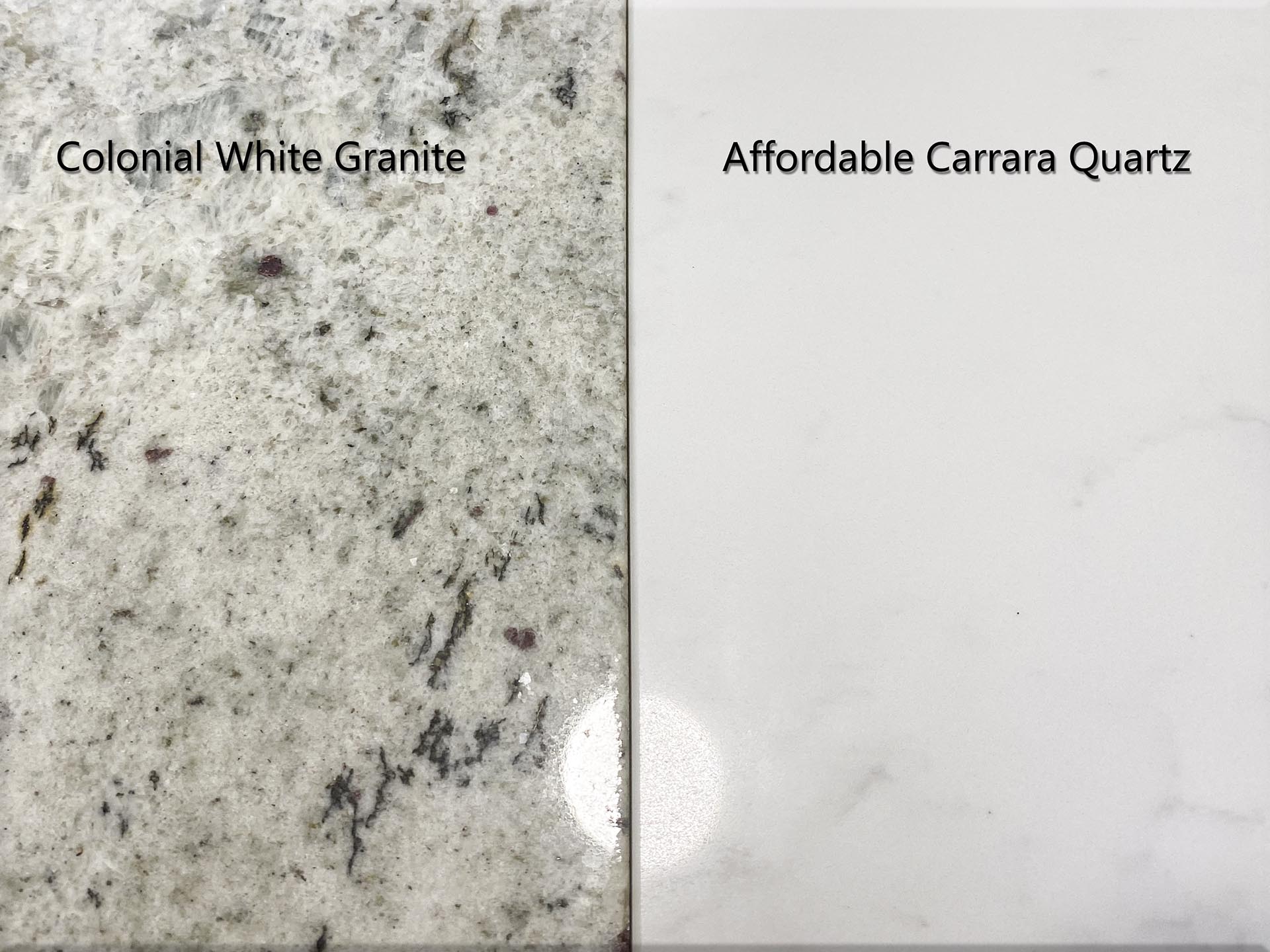
Granite and quartz worktop samples showing the difference in how they reflect a ceiling downlight.
Both samples would be described as having a “polished finish”, but the much higher gloss and reflectivity of the natural granite are clearly visible.
Subsurface Staining
This is where quartz really comes into its own. Because of its resin content, quartz is effectively non-porous. That doesn’t mean, as we have already seen, that it is completely immune to staining, but it does mean that stains cannot penetrate below the surface. A pen mark or curry stain may need a little work to remove, but it will remain on the surface of the material.
Many granites have excellent resistance to staining too. Dark “granites” tend to be genuinely igneous rocks, formed when molten magma crystallises deep beneath the earth’s surface. As a result, they generally have very low porosity and are highly resistant to the penetration of stains. Their dark or black colouring is another advantage: they are neither translucent nor transparent, so even if something did penetrate the surface, there is very little chance of it being visible.
Lighter-coloured “granites”, however, are often metamorphic rocks. These are formed when existing rocks, originally made up of sands and other materials, are transformed by heat and pressure over long periods, with minerals moving through them in solution. They tend to have more, and sometimes larger, pores than igneous rocks. Combined with their lighter colours and translucent crystals, this means that any stains which penetrate the surface can be much more noticeable.
Removing a subsurface stain is extremely difficult, if not impossible, although such marks often fade over time. They are also generally less obvious in stones with more colour and variation in their patterning.
We always advise customers choosing light-coloured granite (and many still do, quite understandably, because of the extraordinary beauty of natural stone) to keep an eye on the condition of the surface sealing, particularly around the sink. If an area of stone starts to darken when it gets wet, it is a sign that water is penetrating the surface. Once that happens, other liquids containing dissolved pigments can potentially follow the same route and leave a subsurface stain.
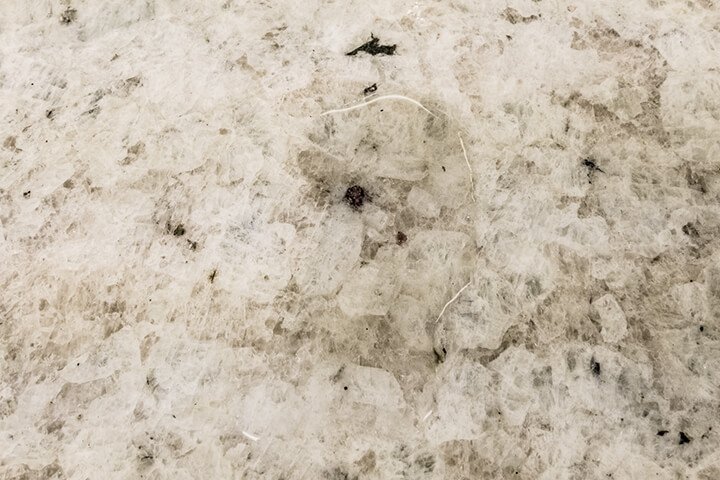
A small pool of water on an unsealed piece of Colonial White granite.
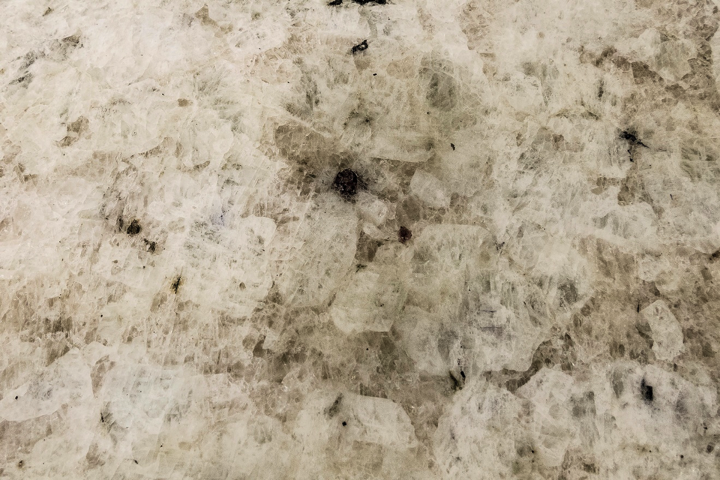
The darker patch remaining after the water has been wiped away shows that moisture has penetrated the stone. If this starts to happen around your sink, it is time to reseal your granite worktop. Don’t worry – it is a straightforward job, and we have a full guide to sealing granite worktops, complete with a helpful video, explaining exactly how to do it.
2 Scratching
Although both granite and quartz are very hard materials, neither is completely scratchproof. They can be scratched by other pieces of stone, ceramic or glass, as well as by diamonds and other extremely hard materials.
One difference we have noticed when comparing granite and quartz samples in our office is the way they show scratches. Dark granites tend to scratch to a similarly dark colour, whereas damaged quartz often reveals a noticeably lighter mark. The result is that black quartz can start to look rather tatty more quickly than a similarly coloured granite. This is a significant advantage for black granite.
It is probably fair to say that the premium quartz brands tend to suffer less from this problem. And, as with staining, patterned surfaces are generally better at disguising scratches and other minor imperfections than plain, uniform colours.
It is also worth putting our observations into context. The large samples in our showroom and office experience a tremendous amount of wear and tear. They are regularly knocked against one another, dragged around and slid across other hard surfaces. A worktop in a normal domestic kitchen is unlikely to experience anything like the same level of abrasion. So, while this is a difference we have observed, it should not be taken as a prediction of how quickly your kitchen worktops will show signs of wear.
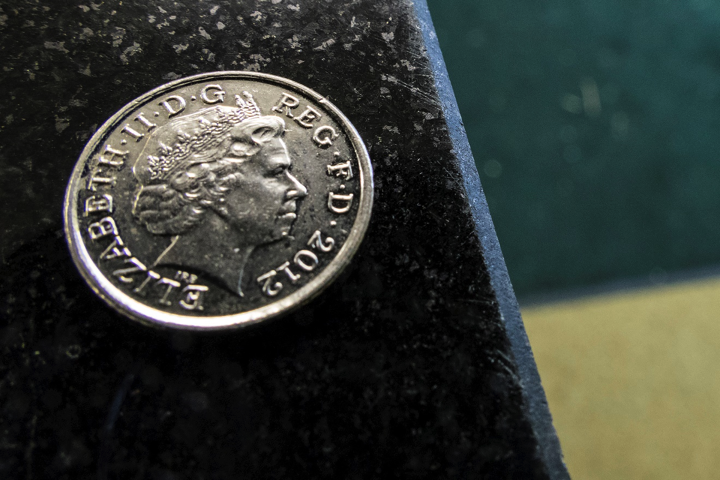
Fine scratches on a piece of Nero Assoluto granite in our showroom, where other stone samples have been dragged across it. The coin is a 5p piece.
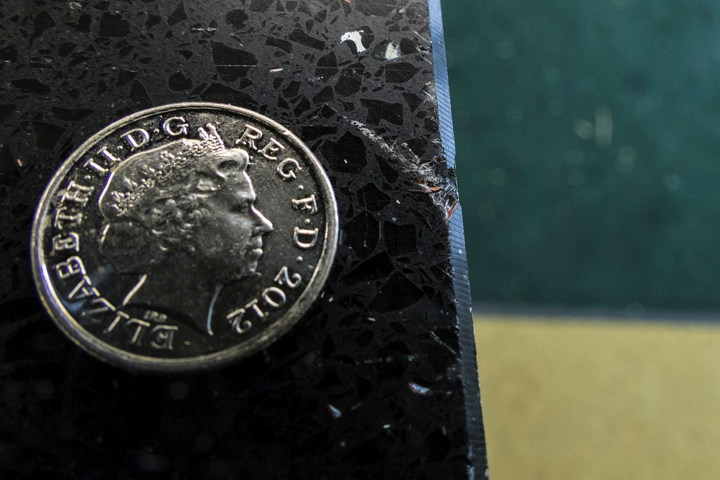
Scratches along the edge of a black, sparkly quartz sample, caused by other samples being knocked or dragged across it. Note the lighter colour exposed by the damage.
Both images show EXTREME abrasion and wear. These are not conditions you would normally expect to encounter in a domestic kitchen.
Staining and scratching are probably the two most important considerations when choosing kitchen worktops, whatever the material or location. Hopefully, the reasons behind our general preference for light-coloured quartz and dark-coloured granite are now clear. However, a little caution is advisable, particularly with more economical white quartz, where surface staining can become an issue in a busy kitchen.
There are, of course, several other differences between the two materials, and in some respects one may have a clear advantage over the other.
3 Tensile/flexural strength
Because of the resin (plastic) content in engineered stone, quartz generally has greater tensile strength than most of the granites used for kitchen worktops. Granite itself varies considerably in this respect, as the stones sold under that name are actually quite different types of rock. True igneous (volcanic) stones tend to be very strong, whereas some of the coarser-grained metamorphic rocks can be comparatively weak.
This can have practical implications when designing and manufacturing worktops. We may need to allow greater minimum clearances around cutouts, restrict maximum overhangs or, in some cases, limit the overall length of a section.
Quartz, with its generally higher tensile strength, offers more flexibility in fabrication and can often be manufactured to tighter tolerances. It is also available in a 20mm thickness, which may be particularly suitable for certain designs. Some contemporary kitchens look better with a slimmer worktop profile, and if that is the look you want, quartz is definitely worth considering.
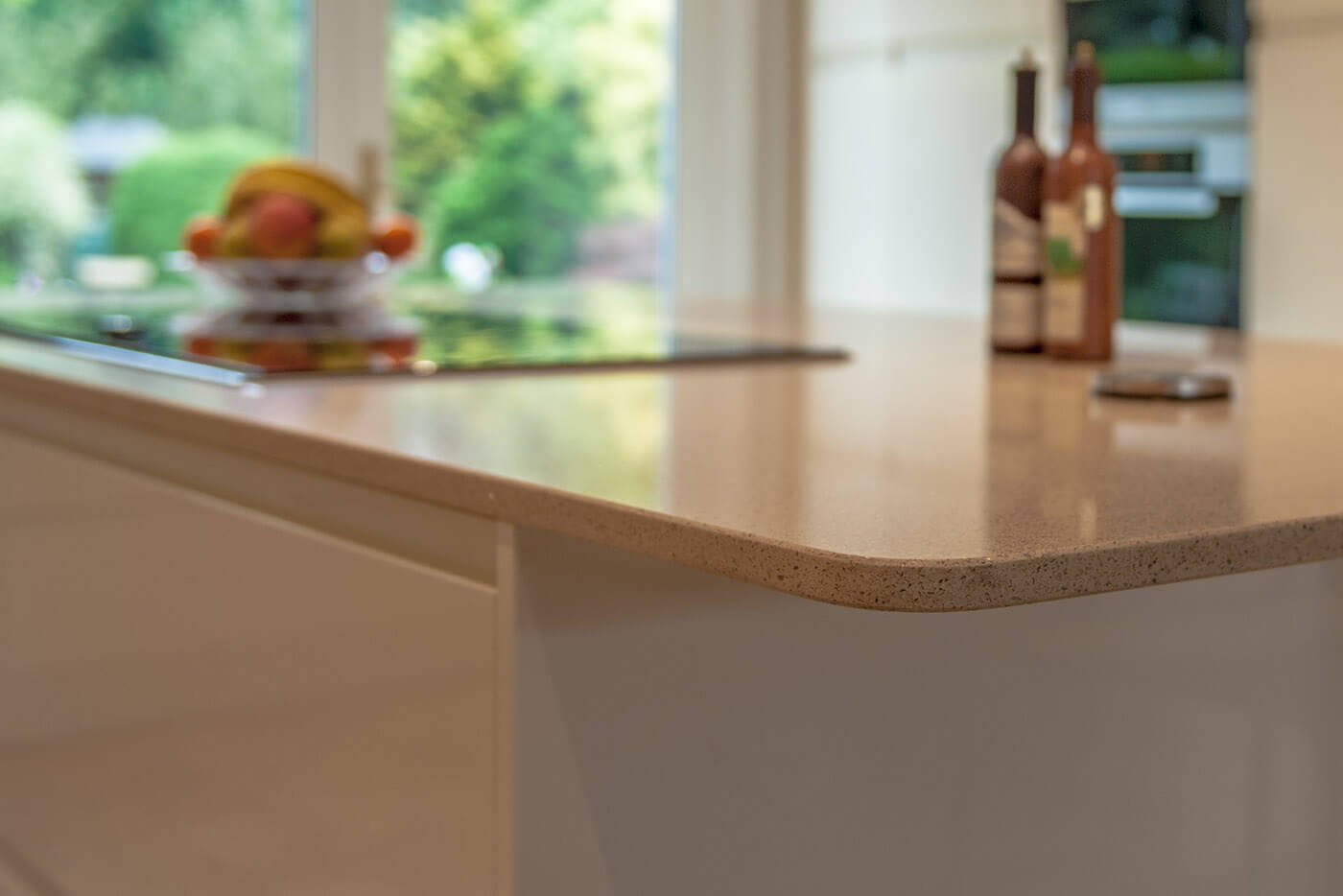
Overhang on island in 20mm thick Cimstone Sines quartz
Horsham, West Sussex
4 Ultraviolet Sensitivity
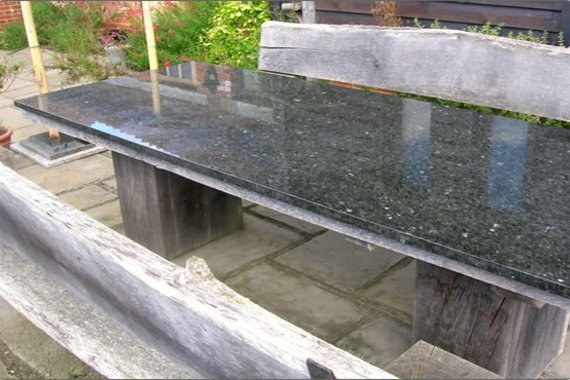
A garden tabletop in granite
The resin content in most quartz worktops can be damaged and gradually broken down by ultraviolet (UV) light. For this reason, until relatively recently, we would only recommend natural stone or ceramic surfaces such as Dekton® for garden tables, outdoor kitchens, barbecue areas and other external applications.
There are now, however, some specially developed ranges of quartz which are UV-resistant and suitable for outdoor installation. So the choice is no longer quite as restricted as it once was.
For a more general look at materials suitable for outdoor use, including a roundup of options for garden kitchens and barbecue areas, take a look at our blog on outdoor barbecue and granite worktops.
Summing up
Remember, both granite and quartz are premium worktop materials. Comparing them is a little like comparing a Porsche with a Ferrari – to someone driving an old Ford, the differences might seem rather academic! Both have significant advantages in the right circumstances, and there is no need to exaggerate the differences. After all, compared with something like wood, with all its maintenance requirements, both materials have a great deal to offer.
We hope you have found this guide to granite and quartz useful. If you would like some straightforward advice or have any further questions, please give us a call on 01293 863992 or get in touch using Live Chat. We are always happy to help.
You might also find these articles useful:
- Stone worktops versus laminate worktops – how do the two compare?
- Kitchen worktops: the different types, with their pros and cons – a broader guide to the many materials available.
- Heat-resistant worktops – a closer look at the heat resistance of granite and quartz.
We are Affordable Granite, the leading granite worktop installers in Surrey, Sussex and across the South East. Our philosophy has always been that honest, straightforward information, provided without pressure, leads to happier customers in the long run. We firmly believe that a helpful, no-nonsense approach is far better than a hard sell.
We hope you have found this article, along with the other guides and advice we publish, both interesting and informative. If you have any further questions, would like some advice or need a quotation for any aspect of worktop installation or kitchen design, please don’t hesitate to get in touch. You can call us on 01293 863992 or email [email protected]. We look forward to hearing from you!
